Cosmology / Research in progress
CosmoPaths
Exploring how modified gravity can connect radiation, matter and late-time cosmic acceleration.

Scientific Question
If a gravity model admits radiation, matter and accelerated expansion individually, can a physically admissible cosmic history connect them? The project investigates the relationship between local stability criteria and global cosmological evolution in metric f(R) gravity.
Current Scope
Research in progress, documented in two reports: an analytical and numerical study of exponential gravity, followed by a derivation and verification of the Amendola dynamical system. A compact formulation with matter and radiation is the next step.
The cosmological sequence
Connecting the eras of the Universe
The project asks whether the familiar local conditions for individual cosmological states are sufficient to permit a complete history within the physical region of the model.
Radiation → Matter → Late-time acceleration
This sequence is the target of the global analysis. Its existence has not yet been demonstrated by the present work.
First model
Exponential gravity
The first report studies a model in which the gravitational function contains an exponential correction to the Ricci curvature scalar R.
For β > 1 and Rs > 0, the report verifies the local matter criterion and the existence of a locally stable expanding de Sitter state. With u = R/Rs, the physical condition fR > 0 requires u > ln β. These checks reproduce known local results and provide a baseline for the global investigation.
Illustrative numerical pilot
Following the expansion
A pilot with β = 2 follows the evolution of normalized densities, curvature and the deceleration parameter q. Negative q indicates accelerated expansion.
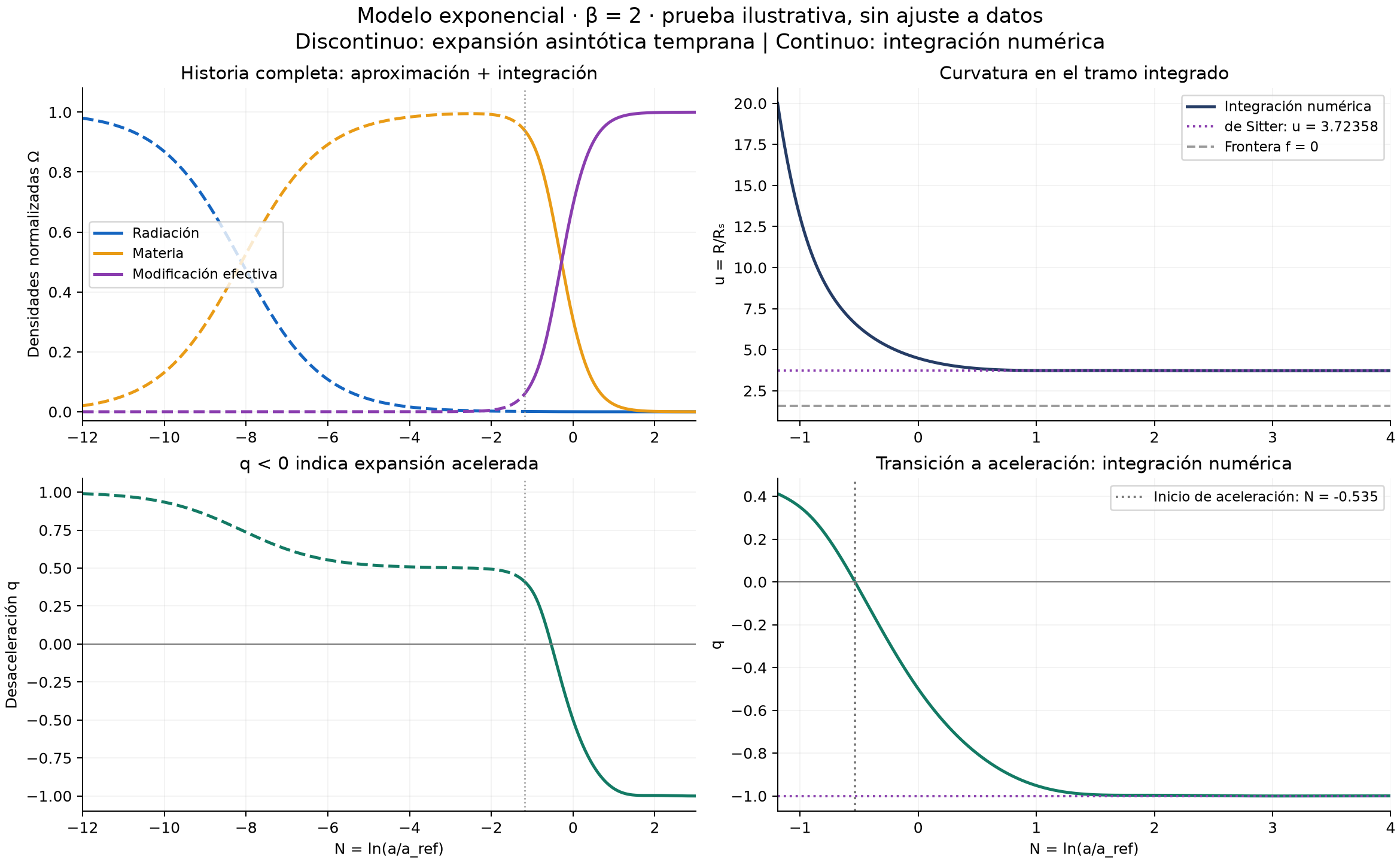
The plotted history joins an early approximation to a late numerical integration. It is not a direct integration from radiation and does not establish global viability or robustness from the radiation era.
Dynamical systems
Local criteria and the global question
The functions m and r encode the model dependence in the conventional dynamical formulation. Subscripts R denote derivatives with respect to the Ricci scalar.
The second report derives the four equations of the Amendola system, checks the Friedmann constraint and fluid conservation, and examines radiation, matter and de Sitter states. The stability calculation retains the dependence m(r).
It also distinguishes singular limits and cases where linearization cannot decide stability. Local fixed points and their eigenvalues do not, by themselves, demonstrate a physical trajectory connecting the cosmological eras.
Two Progress Reports
23 September 2026. Local criteria for exponential gravity and an illustrative cosmological evolution, with numerical consistency checks.
17 October 2026. Derivation and verification of the non-compact Amendola system, including local stability and the limitations of its coordinates.
Next Step
Construct and validate a compact dynamical system with matter and radiation, then examine its physical boundaries and possible connections between cosmological states. Whether additional global viability conditions are needed remains an open research question.
Research Context
Research carried out by Gerardo Mancebo under the supervision of Dr. Ricardo García-Salcedo. This page presents the scope and current progress of the ongoing cosmology project.
Foundational framework: Amendola et al. (2007). Exponential-gravity evolution: Bamba, Geng & Lee (2010).